A complete CPaskal program compiles to C++23, then to a native x86_64 executable via Zig/Clang. Everything you need ships in one ZIP.
module exe demo;

@target x86_64_windows;

// Bind to C library
routine clink c_abs(const n: int32): int32;
  external "c" name "abs";

type
  Point = record
    x: float64;
    y: float64;
  end;

routine distance(a: Point; b: Point): float64;
var dx: float64; dy: float64;
begin
  dx := a.x - b.x;
  dy := a.y - b.y;
  return cpp("std::sqrt(dx*dx + dy*dy)");
end;

begin
  var a: Point = Point(x: 0.0, y: 0.0);
  var b: Point = Point(x: 3.0, y: 4.0);
  println("Distance: {}", distance(a, b));
  println("abs(-42) = {}", c_abs(-42));
end.
$ cpas demo -r

CPaskal CLI v0.1.0
Parsing demo.cpas...
Analyzing...
Generating C++23...
Building demo...
Build succeeded.
Running demo.exe...

Distance: 5
abs(-42) = 42
Familiar syntax, explicit types, full control. These examples show CPaskal's core features.
// Explicit-width types -- no ambiguous "integer"
var count: int32 = 0;
var big:   int64 = 9999999999;
var byte:  uint8 = 255;
var pi:    float64 = 3.14159;
var flag:  boolean = true;
var name:  string = "CPaskal";
var wname: wstring = w"Unicode";

// Pointers with typed syntax
var p: pointer to int32 = address of count;
println("value = {}", p^);  // dereference

// Choices (enums) with explicit values
type
  Color = choices(red, green, blue = 5, alpha);
var c: Color = Color.blue;

// Routine types (function pointers)
type
  BinOp = routine(x: int32; y: int32): int32;
var op: BinOp = add;
println("result = {}", op(3, 4));
// Records with inheritance, packing, alignment
type
  Base = record
    x: int32;
    y: int32;
  end;

  Derived = record(Base)
    z: int32;
  end;

  Packed = record packed
    a: int8;
    b: int32;
  end;

// Overlays (C unions)
  Value = overlay
    asInt: int64;
    asFloat: float64;
  end;

// Bit fields for hardware/protocol work
  StatusReg = record
    ready: uint32 : 1;
    mode:  uint32 : 3;
    data:  uint32 : 8;
  end;

// Record literals -- named initialization
var pt: Base = Base(x: 42, y: 99);
// if/then/else with end
if x > 0 then
  println("positive");
else
  println("non-positive");
end;

// for with to/downto
for i := 1 to 10 do
  total += i;
end;

// while loop
while count < 100 do
  count += 1;
end;

// repeat..until
repeat
  count += 1;
until count >= 10;

// match with ranges and multi-labels
match value of
  0:        println("zero");
  1, 2, 3: println("low");
  4..10:   println("mid");
else
  println("high");
end;
// Four module kinds
module exe  myapp;      // executable
module dll  mylib;      // shared library (DLL/SO)
module lib  mystaticlib;// static library
module unit myutils;    // importable unit

// Import and use with full qualification
import myutils;
println("version = %d", myutils.UTIL_VERSION);
println("add = %d", myutils.util_add(3, 4));

// Public/private visibility
public const VERSION: int32 = 1;
const SECRET: int32 = 42; // private

public routine add(a: int32; b: int32): int32;
begin
  return a + b;
end;

// Module lifecycle
initialize
  println("starting up...");
end;

finalize
  println("shutting down...");
end;
// guard/except/finally -- catches software AND hardware exceptions
guard
  result := a div b;
except
  println("error: code={}, msg={}", exccode(), excmsg());
finally
  cleanup();
end;

// Throw with message or code
throw("something went wrong");
throwcode(404, "resource not found");

// Hardware exceptions caught automatically
guard
  x := 10 div 0;  // divide by zero
except
  println("caught: {}", excmsg());
  // prints: "Divide by zero"
end;

// Exception propagation across modules
guard
  myutils.dangerous_operation();
except
  println("caught from unit: {}", excmsg());
end;
// External clause -- bind to any C library
routine clink abs_val(const n: int32): int32;
  external "c" name "abs";

// Windows API
routine clink GetTick(): uint64;
  external "kernel32" name "GetTickCount64";

// Third-party library via const
const RAYLIB: string = "raylib";
routine clink InitWindow(w: int32; h: int32;
  title: pointer); external RAYLIB;

// Raw C++ injection
cppstart header
#include <cmath>
cppend

// Inline C++ expressions
var sq: float64 = cpp("std::sqrt(2.0)");

// Conditional compilation for platform code
@ifdef TARGET_WIN64
  println("tick: {}", GetTick());
@endif
// Built-in unit testing framework
module exe mathlib;

@unittestmode on;

routine add(a: int32; b: int32): int32;
begin
  return a + b;
end;

end.

// Test blocks appear after end.
test "add returns correct sum"
begin
  asserteq(5, add(2, 3));
  asserteq(-2, add(-5, 3));
end;

test "add handles zero"
begin
  asserteq(0, add(0, 0));
  asserttrue(add(1, -1) = 0);
end;
Clean syntax, explicit types, full control over memory and ABI. No hidden complexity.
external clause. Produce C-compatible DLLs and static libraries that Python, Rust, Go, C# and any other language can call.cppstart/cppend blocks and cpp() expressions.guard/except/finally catches both software exceptions and hardware faults like divide-by-zero and access violations. Propagates across module boundaries.exe, dll, lib, unit. Public/private visibility. Full module qualification eliminates name collisions. Initialize/finalize lifecycle hooks..cpas module.The AST is the single source of truth. Each stage enriches it, codegen emits C++23, and Zig/Clang compiles to native.
.cpas source. Keywords and all 16 primitive types are dynamically registered with their C++23 mappings. Nothing hardcoded.zig.exe bundles Clang and its own build system into a single tool. It compiles the C++23 output to the target platform (Win64 or Linux64) entirely from Windows. No separate toolchain installation required.The C boundary is paper-thin. Bind to any C library with a single declaration. Produce DLLs and static libraries the rest of the world can call.
// Bind to libc
routine clink toupper(const c: int32): int32;
  external "c" name "toupper";

// Bind to raylib via CImporter-generated unit
import raylib;
raylib.InitWindow(800, 600, cstr("Hello"));

// Bind to Windows API
@ifdef TARGET_WIN64
routine clink GetTick(): uint64;
  external "kernel32" name "GetTickCount64";
@endif

// Bind to Linux API
@ifdef TARGET_LINUX64
routine clink getpid(): int32;
  external "c" name "getpid";
@endif
// Build a DLL any language can call
module dll mathlib;

public routine clink add(
  a: int32; b: int32): int32;
begin
  return a + b;
end;

public routine clink factorial(
  n: int32): int32;
var result: int32 = 1;
    i: int32;
begin
  for i := 1 to n do
    result *= i;
  end;
  return result;
end;

end.

// Result: mathlib.dll with standard C ABI
// Callable from Python, Rust, C#, Java...
The CImporter tool reads C header files and auto-generates CPaskal import units. It uses tinycc for preprocessing, then translates types, constants, and function declarations to .cpas syntax. Binding to raylib, SDL3, SQLite, or any C library is one command away.
CPaskal is a systems programming language. It belongs in the same conversation as C, C++, Rust, and Zig.
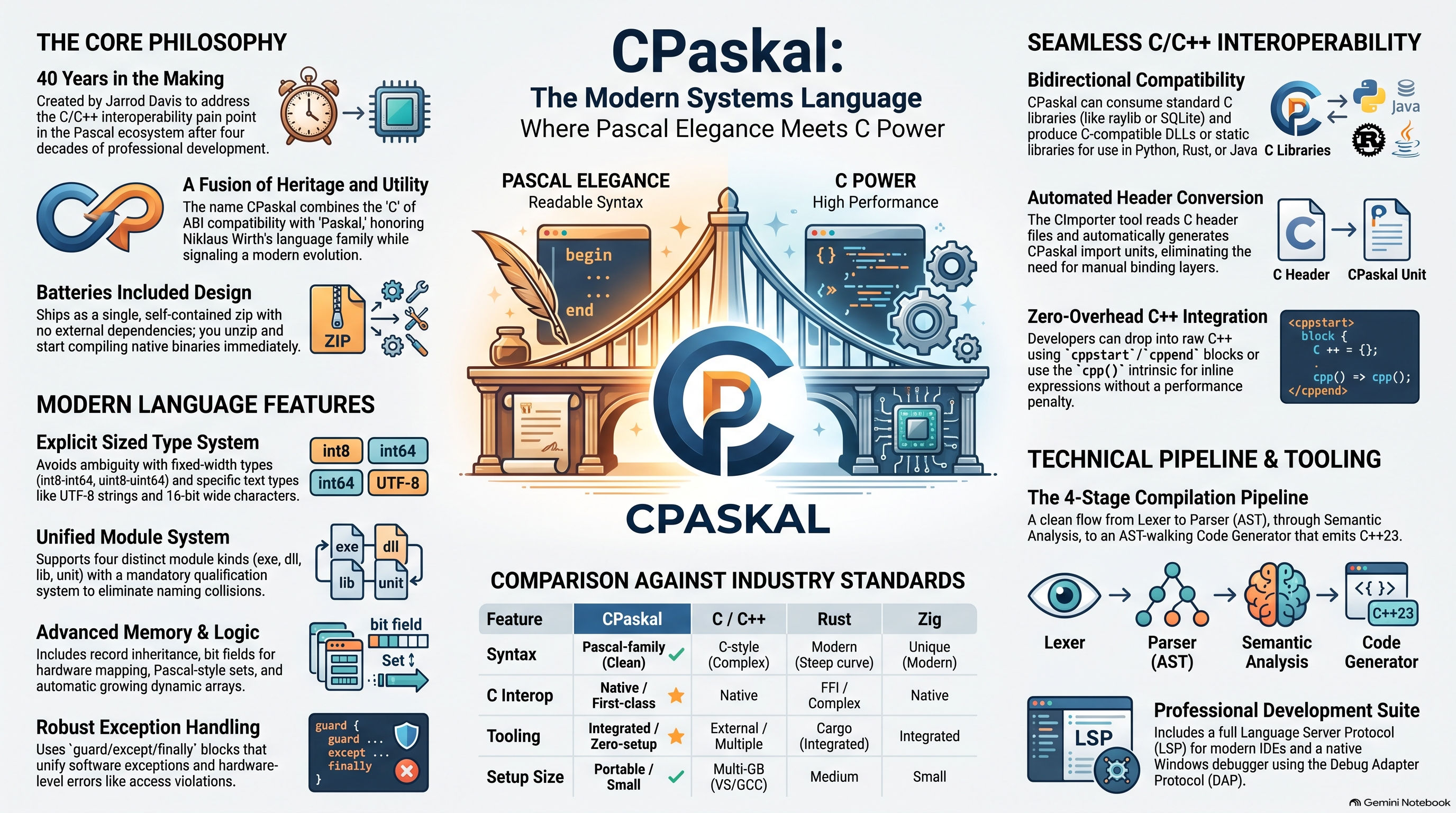
Infographic, walkthroughs, and a deep-dive podcast into the language design.
No SDK, no package manager, no setup wizard. Unzip and go.
cpas compiler, the Zig/Clang toolchain, and the C++23 runtime. No installers, no SDKs, no setup. You're ready to compile.